search

Contact Person:Guo Rong
telephone:+86 173 0644 8312
Email:sales@soloakoptics.com guorong3412@gmail.com
Address:10F, Building 2A, U Valley, Fuzhou IoT Industrial Park, No. 12 Xingye West Rd., Mawei District, Fuzhou, Fujian, China

Image source: Canon
Utsunomiya City, located about 100 kilometers north of Tokyo, is the location of a factory for Canon EF lenses, as well as lenses for products including video cameras, broadcasting equipment, and projectors.
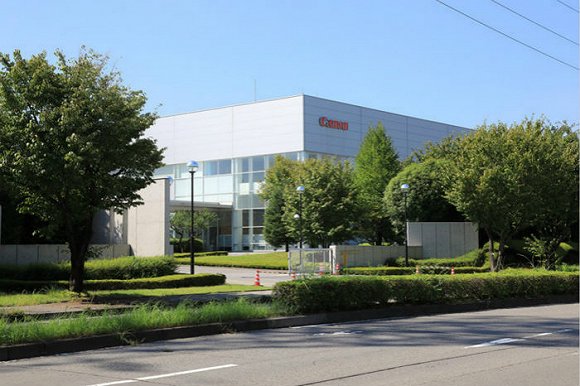
Canon Utsunomiya Factory
This is the headquarters of Canon's optical research, mainly researching various optical lenses and providing technical support to Canon's other factories. In order to manufacture ideal lenses, Canon factories not only make full use of their long-term accumulated optical technology for production, but also complete various precision assemblies of lenses through self-developed devices.
To the north of the Utsunomiya factory is Canon's proud optical research and development center, where all Canon lens development and design are completed and then handed over to the opposite factory for further production and manufacturing.
As of 2014, this factory was responsible for producing 100 million EF lenses. Behind each lens, there are not only improvements and innovations in modern craftsmanship, but also the inheritance of craftsmanship by artisans.
According to the person in charge of Canon's Utsunomiya factory, the birth of EF lenses for all digital cameras requires multiple processes such as spherical lens processing, SWC (sub wavelength structure coating), and assembly. The polishing of only spherical lenses requires a series of tedious but essential fine processes such as rough grinding, fine grinding, coring, rough polishing, and fine polishing, and each process has strict standards.

The main tools and lenses required for producing spherical lenses
Especially in the most important grinding process of producing lenses, this standard is even more stringent. The finished lenses we usually see are crystal clear, but their original "body" is a glass blank with a frosted visual effect. After completing grinding, smoothing, polishing, center positioning, cleaning, and final inspection, the finished lens will appear in its original state. Canon requires that the roughness of the lens surface must be controlled at 0.8 nanometers, and the surface error accuracy must be strictly controlled at 0.06mm. If a lens is enlarged to the size of the National Stadium of the Bird's Nest, it means that the surface error of the Bird's Nest cannot exceed 2mm.
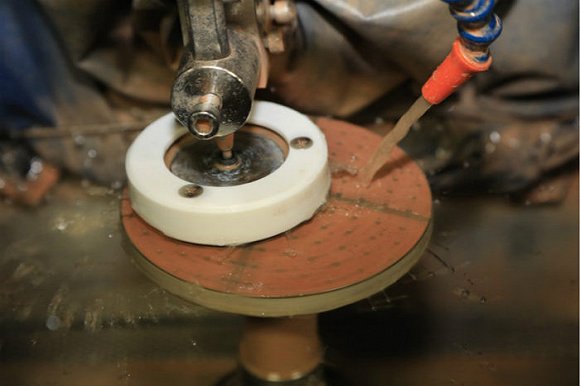
镜片加工
尽管佳能镜片已经实现了自动化生产,但为了打造出高精度的镜片,其所使用的磨具无法进行机器加工,必须由具备熟练技能的工匠来制作手工磨具。

Polishing grinding tool
Canon lens polishing senior technician Toshio Saito is such a unique craftsman.
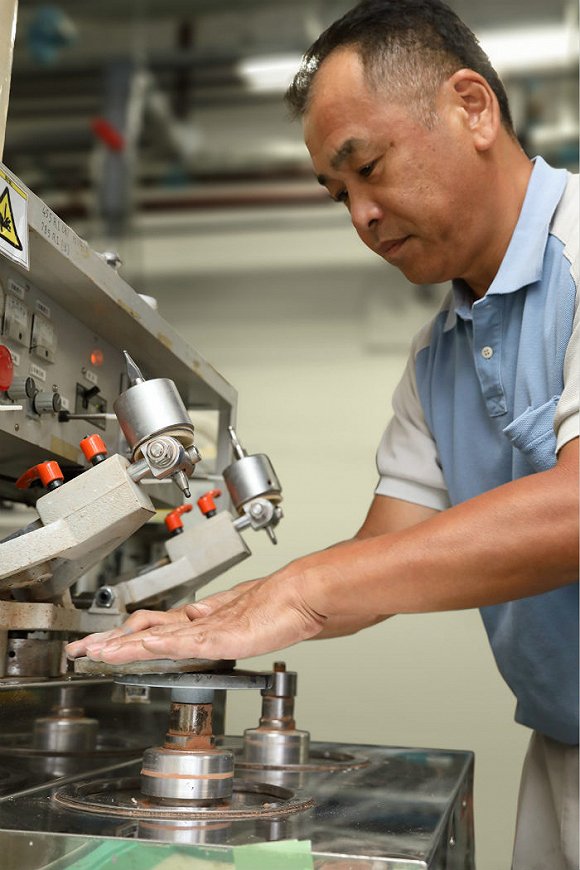
Canon Lens Polishing Senior Technician Toshio Saito
He joined the Utsunomiya factory in 1981 and has been dedicated to the processing technology of optical lenses for 37 years. He was rated as an S-level craftsman (a fairly high-level craftsman). At present, many of the grinding tools used in the factory are handmade by Toshio Saito. To control the accuracy of the grinding tools, it relies on his years of training experience and a special skin sensation on his hands. As long as he touches it with his hand, he can determine whether the grinding tool meets the required standards.
At present, he is not only responsible for the processing planning stage of ultra high precision lenses, but also for supervising the training of workers in the next generation of factories.
I feel honored for my current job. It is through countless polishing and lens grinding that I have become the person I am today, "said Toshio Saito. He is pleased to see that the grinding work of Canon broadcasting equipment is entrusted to a new generation of young craftsmen and will continue to cultivate more craftsmen.
Miyoko KobanaWa, who is responsible for managing the EF lens assembly workshop, is also an S-level craftsman. She entered Canon two years later than Toshio Saito and has extensive experience in manually assembling lenses.
A Canon lens, especially some high-end lenses with red circles, will be equipped with many lenses and transmission devices. Any slight deviation of each component may affect the overall optical performance of the lens. So some lenses can be completed by machines, but some high-end lenses still require experienced craftsmen like Miyoko KobanaWa to manually assemble them, while others are a combination of machines and manual labor.

Assembly of individual components of the lens barrel
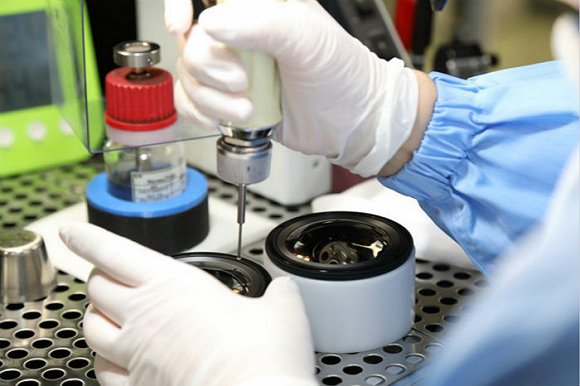
Lens assembly
Canon also showcased the SWC (subwavelength structure coating) process to the media for the first time. If glass products are not processed, reflection usually occurs when light penetrates. To solve the above problems, a common process is to add a very thin film, but it is easy to experience ghosting in strong light, known as the "ghosting" phenomenon.
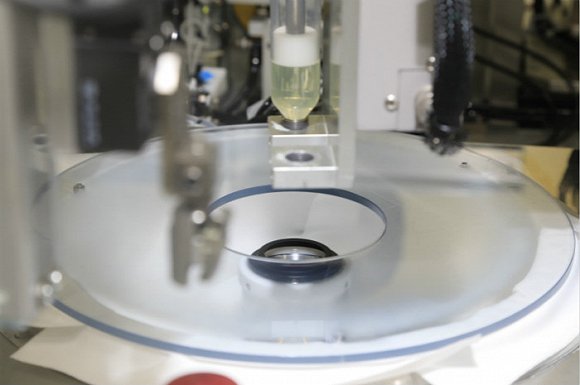
SWC coating material coating
Canon, on the other hand, came up with the idea of gradually changing the refractive index to avoid light reflection. The specific approach is to strictly control the water temperature, and through material coating, firing and other processing steps, form a perfect crystalline coating surface, making the light more smoothly transition to the surface of the glass lens.
Due to the difficulty of the above process, SWC is currently only used on Canon's high-end lenses. But Canon factories are also constantly improving the qualification rate of this process, hoping to apply it to more lenses.
telephone:
+86 173 0644 8312
email:sales@soloakoptics.com guorong3412@gmail.com
address:10F, Building 2A, U Valley, Fuzhou IoT Industrial Park, No. 12 Xingye West Rd., Mawei District, Fuzhou, Fujian, China